How to Calculate Bread Hydration: A Baker’s Guide
Great bread differs from good bread through exact measurements and techniques. Bakers who know how to calculate bread hydration can better control their loaves’ texture, crust, and quality. Professional bakers consider this skill a foundation for creating consistent, high-quality results.
Baker’s percentages, accurate measurements, and flour-specific adjustments are vital to becoming skilled at bread hydration calculations. This detailed guide walks through the simple hydration formula and shows how to adjust hydration levels for different bread styles. You’ll see how varying hydration percentages shape your bread’s texture and crumb structure. The guide offers practical techniques to enhance your bread-making through proper hydration control.
Understanding Bread Hydration
Bread hydration is the ratio of water to flour weight in a recipe, shown as a percentage. This basic concept affects every part of bread making, from how you handle the dough to your loaf’s final texture.
Hydration levels lead to different bread characteristics:
- 50-57%: Creates stiff dough ideal for bagels and pretzels, resulting in dense crumb
- 58-65%: Perfect for standard sandwich bread with a balanced texture
- 65-80%: Produces artisanal bread with open crumb structure
- Above 80%: Yields very wet doughs like ciabatta with large, irregular holes
Your flour choice greatly affects hydration needs. Bread flour and whole wheat flour need more water than all-purpose flour to achieve similar results. For instance, bakers add 5-10% more water when using whole grain flours because these flours absorb more water.
Doughs with higher hydration (above 75%) create bread with thinner crusts and more open crumb structures, though bakers find them harder to handle. Lower-hydration doughs feel firmer and shape easier but make denser breads. Once they understand these relationships, bakers can adjust hydration levels to achieve their desired bread characteristics.
Basic Hydration Calculation Formula
Bread hydration calculations use a simple mathematical formula that helps bakers achieve consistent results. The formula expresses hydration as a percentage by dividing water weight by flour weight and multiplying by 100.
You can calculate bread hydration by following these steps:
- Weigh all ingredients using a kitchen scale
- Divide water weight by flour weight
- Multiply the result by 100 to get the percentage
A recipe with 15 ounces of flour and 10 ounces of water will have a 67% hydration level (10 ÷ 15 × 100 = 67%). This creates a moderately airy crumb structure in your finished bread.
Baker’s percentages use flour as the baseline 100% of the formula. Other ingredients appear as percentages relative to flour weight. This approach lets bakers scale recipes while keeping proper ratios intact.
Remember that flour types absorb water differently because of their protein content. Your recipe might achieve perfect consistency at 75% hydration with all-purpose flour but needs adjustments to 73% or 77% with different brands or types. Professional bakers adjust their recipes based on flour characteristics and environmental conditions to maintain consistent dough texture.
Adjusting Hydration in Recipes
Bakers achieve the best results by making precise adjustments to bread hydration in their recipes under different conditions. The “hold-out water” technique works best, especially with new recipes or high-hydration doughs. This technique lets you keep some water separate while mixing.
To cite an instance, see how a baker might handle an 80% hydration recipe:
- Start with 74% water in the original mix
- Reserve 6% as hold-out water
- Add small amounts gradually as needed
- Weigh the remaining water to calculate the actual hydration
Bakers can fine-tune hydration levels with a quick calculation: divide the flour weight by 100 to find how many grams makeup 1% of hydration. With 450g of flour, each 1% change equals 4.5g of water.
The environment plays a big role in hydration adjustments:
- Less water is needed in high-humidity
- Dry conditions need more water
- Seasonal temperature changes affect absorption
- Different mixing methods change hydration needs
Working with whole grain flour requires extra attention since it usually needs 5-10% more hydration than white flour to achieve a similar consistency. The dough texture tells you everything during mixing—adequately hydrated dough feels slightly tacky but not sticky and stretches without breaking.
Advanced Hydration Considerations
Bread hydration calculations go beyond simple flour and water ratios due to complex ingredients that substantially affect the process of hydration calculations. Bakers need to think about the water content of additional ingredients while working with enriched doughs:
- Butter: Contains ~15% water
- Whole eggs: Approximately 75% water
- Milk: Contains much water content
- Oil: Does not contribute to hydration
Preferment considerations play a crucial role in overall hydration calculations. Each preferred style needs specific hydration levels:
- Poolish: 100% hydration (equal parts flour and water)
- Biga: 50-60% hydration (stiffer consistency)
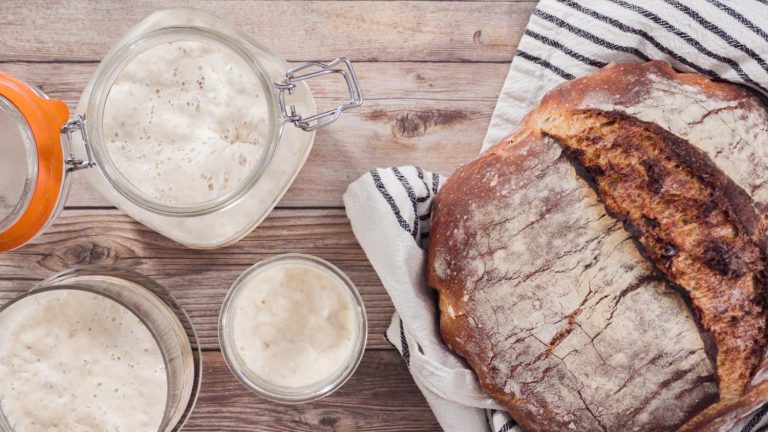
- Sourdough starter: The baker managed to keep it at 80-100% hydration
Note that water bound in emulsions (like butter) acts differently from free water in dough development. Despite having the same theoretical moisture, a dough made with 100g water and 100g butter shows substantially different characteristics than one with 117g water alone.
Bakers should establish the base hydration using flour and water before adjusting for enriched ingredients while calculating advanced hydration. The main dough hydration should be reduced by 1-2% to achieve precise results with substantial amounts of enriched ingredients.
Doughs with high hydration (above 75%) create:
- Thinner, crispier crusts
- Faster fermentation rates
- More extensible dough structure
- Improved potential for open crumb
Conclusion
Becoming skilled at bread hydration calculations gives bakers exact control over their products. They can create dense, chewy bagels or light, airy ciabatta. Professional bakers get consistent results when they pay close attention to hydration percentages. They understand simple water-to-flour ratios and complex interactions with enriched ingredients. These calculations work together with knowledge of flour characteristics and environmental factors. Bakers can adjust their recipes with confidence to get the best results.
Great bread baking just needs continuous learning and the right tools. Each loaf becomes better than the last. Home bakers and restaurant owners who want exceptional bread and pizza with authentic sourdough flavor can contact john@theyeastwecando.com. The Yeast We Can Do offers a premium small-batch sourdough starter. With solid hydration knowledge and quality ingredients, bakers control their bread’s texture, crumb structure, and crust development. Every baking session becomes a chance for artisanal excellence.
FAQs
What does it mean when bread dough is described as having a certain hydration percentage?
The hydration percentage in bread dough refers to the ratio of water to flour by weight, expressed as a percentage. For instance, 50% hydration means that for every 100 grams of flour, there are 50 grams of water. This ratio is crucial as it influences the dough’s texture and the final bread’s characteristics.
How can I determine the ideal hydration level for bread?
The ideal hydration for bread varies depending on the type of bread you are making. Generally, higher hydration results in a more moist dough that produces bread with a more open crumb. For example, a dough hydration of 60% is common, where 60% of the flour’s weight is water.
What is meant by 70% hydration dough?
A 70% hydration dough means that the water weight is 70% of the flour weight. This type of dough is typically stretchy and sticky, which can be challenging to handle but results in a light, soft crust, particularly desirable in pizzas.
What is the significance of 50% hydration in the dough?
A dough with 50% hydration means that the amount of water is half that of the flour by weight. This lower hydration ratio generally leads to a firmer dough and is often used for breads that require a tighter crumb structure.
How do you calculate the hydration percentage of a sourdough starter?
To calculate the hydration percentage of a sourdough starter, divide the water’s weight by the flour’s weight and multiply by 100. For instance, if your starter consists of 50 grams of water and 50 grams of flour, the hydration is (50g water / 50g flour) x 100 = 100%.
How can I compute the hydration percentage of my dough recipe?
To find the hydration percentage of your dough, divide the total weight of the water used by the total weight of the flour and then multiply by 100. This calculation gives you the hydration percentage, which helps you understand the dough’s consistency and handling characteristics.
Lorem ipsum dolor sit amet, consectetur adipiscing elit. Ut elit tellus, luctus nec ullamcorper mattis, pulvinar dapibus leo.